Non Destructive Testing
Non Destructive Testing/Non Destructive Inspection
Non Destructive testing (NDT), sometimes referred to as Non Destructive inspection, refers to a wide group of inspection methods used to analyze the soundness of a material, component, or structure without physically or chemically altering it. American Testing Services offers a comprehensive array of conventional and advanced NDT capabilities and perform visual inspection in conjunction with all of our test methodologies.
American Testing Services offers Non Destructive Testing and Non Destructive Inspection services on your schedule. When necessary, our labs can operate 24/7 to accommodate your timeline.
American Testing Services’ NDT methods are available both in our facility and in the field. Our team is trained in proper safety procedures for field inspections including fall protection, confined space, and personal protective equipment.
Whether you need standard Non Destructive Inspection and Non Destructive Testing Services or you need a custom NDT solution, American Testing Services is your source for Non Destructive Testing and Non Destructive Inspection you can trust. Contact American Testing Services today, and let our team give you the peace of mind you deserve!
Our Nondestructive Testing Capabilities
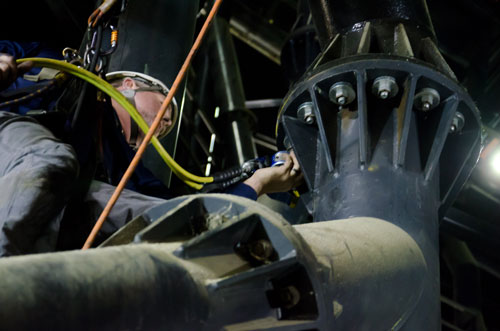
Bolt Torquing
Bolt torquing is a critical component of non-destructive inspection and non-destructive testing (NDT), ensuring mechanical fastenings perform efficiently and safely on large structures and industrial equipment. These structures may include thousands—sometimes millions—of individual bolts that require routine inspection and testing to verify structural integrity and identify potential signs of weakness before failure occurs. Bolt torquing is performed on location and may be conducted in conjunction with our industrial rope access services to safely reach complex or elevated work areas.
At American Testing Services, our certified personnel support a full range of bolt and fastener sizes and provide non-destructive testing and inspection services with the capability to apply up to 10,000 PSI, producing 3,230 foot-pounds of torque. This ensures fasteners meet engineering specifications without causing damage to the structure or components.
Certified Weld Inspector Services (CWI)
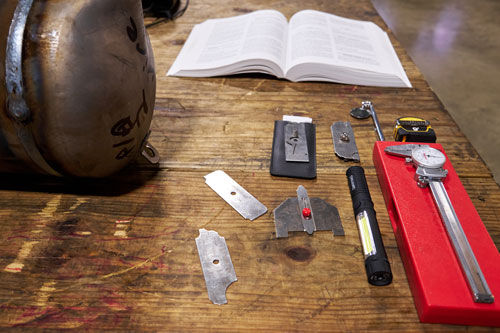
The American Welding Society created the Certified Weld Inspector (CWI) program to accredit welding inspectors to the highest industry standards. The program ensures that welding inspection, oversight, and nondestructive testing (NDT) for welding are performed with rigor and consistency, so welded parts and projects meet the quality, safety, and performance requirements defined by their engineering design.
AWS-CWI services cover a wide range of welding inspection requirements. Unlike traditional non-destructive inspections, CWI services can start prior to any welding operations. In some cases, this service is a complete oversight of a welding or fabrication project – verifying, documenting, and reporting per the given requirements. This can include welder certifications, material certifications, and welding filler material certifications. Additional requirements could include verifying and documenting weld prep, weld pre-heat / post-heat, machine settings, equipment calibrations, monitoring weld sizes, and visual inspections as the work progresses. Additional NDT might also be included during and/or after all welding operations are complete. A comprehensive report with all of the required documentation is presented to the customer upon the welded part or project completion.
Contact American Testing Services if you have a project requiring CWI services or if you’re quoting a weld project with CWI requirements. We can walk you through the steps to ensure all of your customer’s needs are met. It is important to engage early on any project with a CWI requirement to avoid a costly situation for you and your customer if important milestones in the process are skipped.
Eddy Current
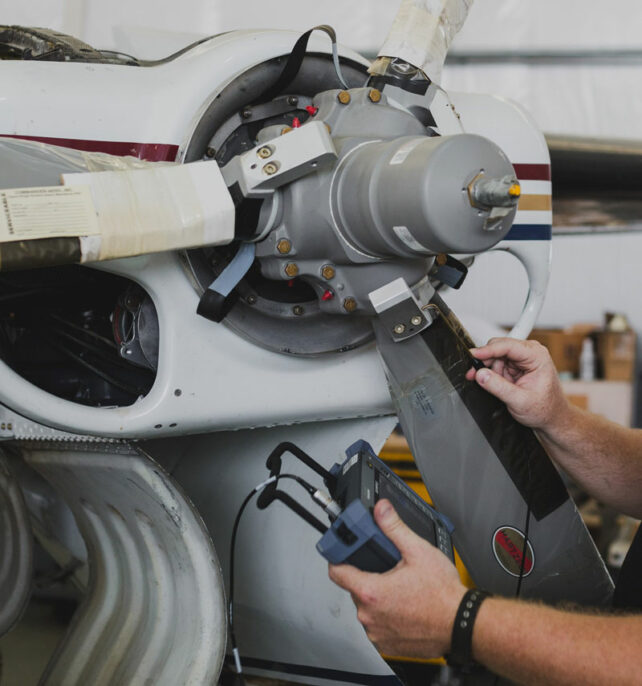
Utilizing electromagnetic induction in conductive materials, eddy current inspection is a non-destructive testing (NDT) and non-destructive inspection method used to detect surface and near-surface defects in a wide range of components. Eddy current testing can also provide accurate material and coating thickness measurements without damaging the part, making it an excellent solution for research and development, manufacturing quality control, and in-service inspections.
At American Testing Services, our highly trained technicians perform non-destructive testing and inspection services using specialized eddy current equipment and advanced analysis software. This approach minimizes downtime in manufacturing and repair processes while reducing overall inspection costs. Our experienced inspectors deliver reliable data ranging from basic thickness measurements and material conductivity evaluations to complex analyses of aerospace-grade engineering materials.
Liquid Penetrant
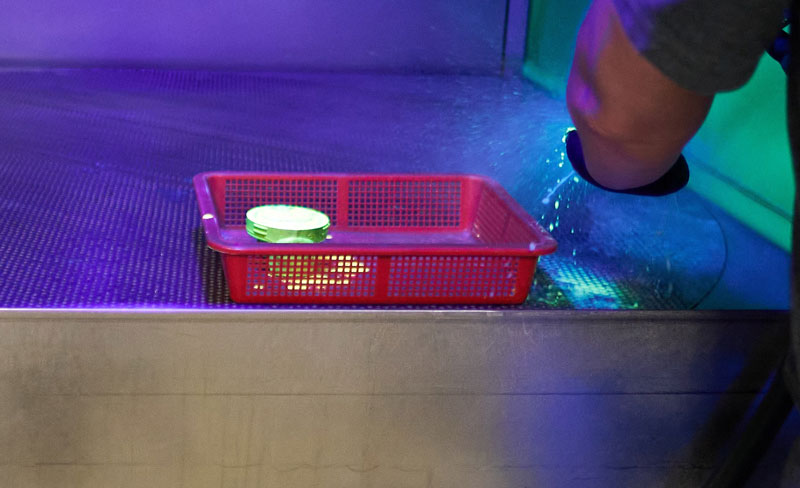
Liquid penetrant inspection is a non-destructive testing (NDT) and non-destructive inspection method used to identify surface-breaking discontinuities such as cracks, laps, seams, and porosity. This technique is widely used due to its cost-effectiveness, portability, and versatility across a broad range of materials, sizes, and component geometries. The penetrant dye is able to enter extremely fine surface defects that would not be visible to the unaided human eye, making it a reliable solution for early defect detection.
At American Testing Services, we perform comprehensive non-destructive testing and inspection services using both fluorescent and visible liquid penetrant methods, including water-washable and post-emulsified applications. These inspections can be conducted in-house at our laboratory or in the field, providing flexible, code-compliant solutions to support manufacturing, maintenance, and repair operations.
Magnetic Particle
Magnetic particle inspection is a non-destructive testing (NDT) and non-destructive inspection method used to locate surface and near-surface discontinuities in ferromagnetic materials. This technique is effective across a wide range of part sizes and geometries and is valued for its cost-efficiency and ability to deliver immediate results. Similar to liquid penetrant inspection, magnetic particle inspection makes fine linear discontinuities—such as cracks, laps, seams, and inclusions—clearly visible to the human eye for reliable detection.
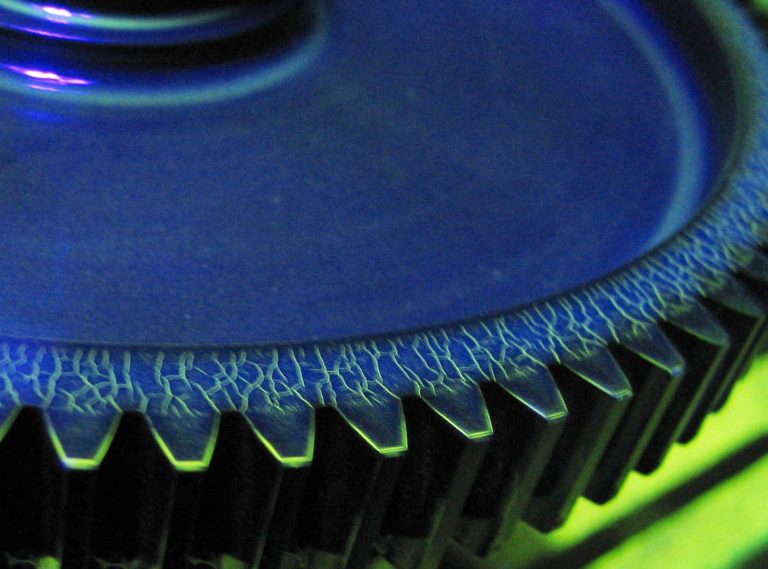
At American Testing Services, our certified technicians provide comprehensive non-destructive testing and inspection services using both fluorescent and visible magnetic particle inspection methods. Inspections can be performed in our laboratory or on-site, allowing us to support manufacturing, fabrication, and maintenance programs with flexible, code-compliant solutions.
Radiography/Computerized Radiography
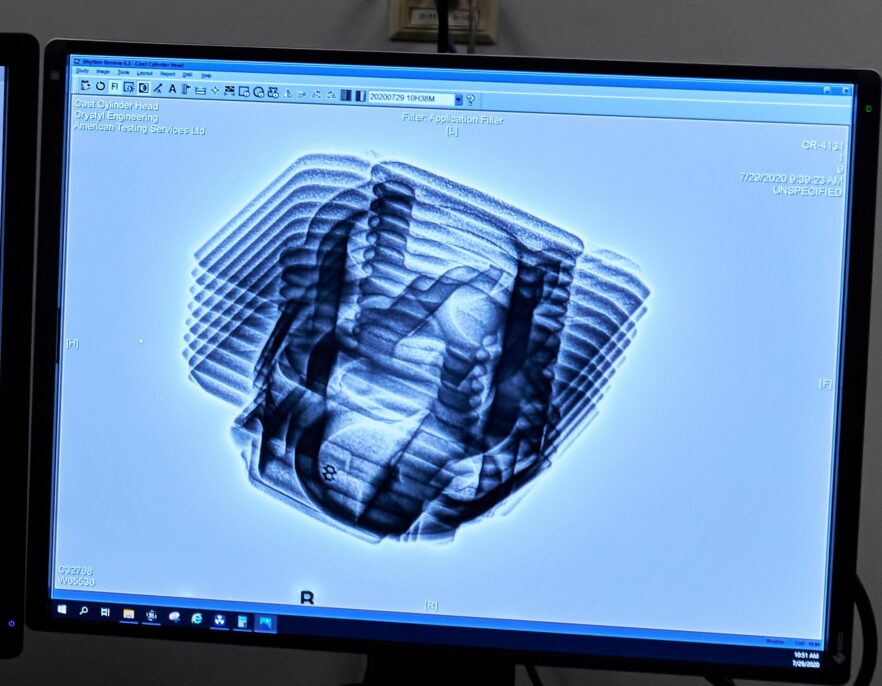
Radiographic inspection is a non-destructive testing (NDT) and non-destructive inspection method that uses X-rays to perform a volumetric assessment of raw materials, including castings and finished components. This inspection technique allows internal defects to be identified without damaging the part and can be performed in our laboratory using conventional film radiography or through computerized imaging for advanced analysis and interpretation.
At American Testing Services, our computerized radiography non-destructive testing and inspection services offer significant advantages over traditional film radiography. These benefits include high-resolution digital images, faster exposure times, elimination of film and chemical processing, and improved reliability and repeatability. Our highly trained technicians utilize advanced software tools to accurately detect, size, and evaluate defects, supporting critical quality, safety, and compliance requirements.
Ultrasonic
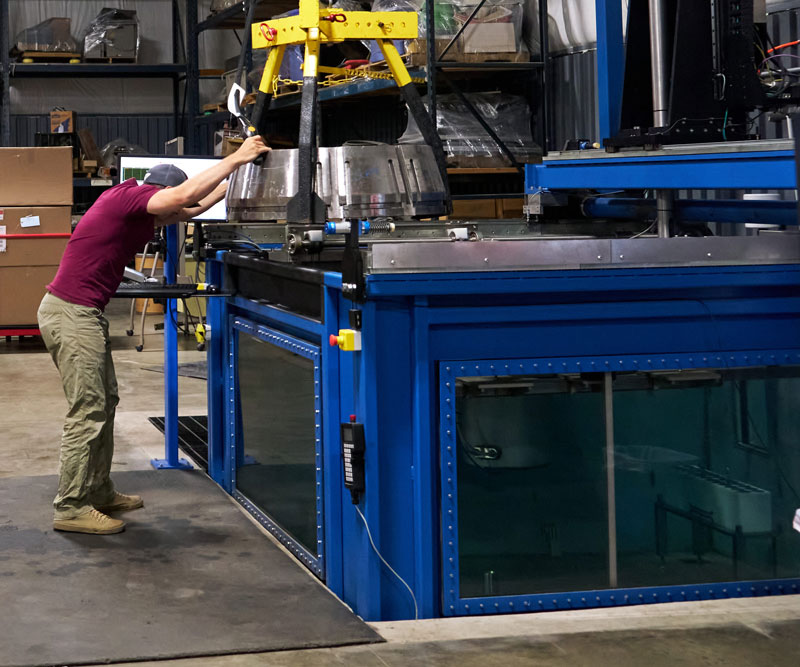
Ultrasonic inspection is a non-destructive testing (NDT) and non-destructive inspection method that uses high-frequency sound waves to detect internal imperfections and changes in material properties. This technique is commonly used to perform volumetric inspections on raw materials, in-process components, and finished parts. Ultrasonic testing is highly versatile and can be applied to a wide range of materials, including exotic metals and composite structures.
At American Testing Services, our certified technicians provide comprehensive non-destructive testing and inspection services through both contact ultrasonic inspections and advanced automated solutions. We offer 100% full volumetric inspection using our automated 6-axis immersion ultrasonic systems, which enable precise, repeatable scanning for the detection of cracks, voids, delaminations, and other internal defects—supporting critical quality, safety, and performance requirements.
Visual Inspection
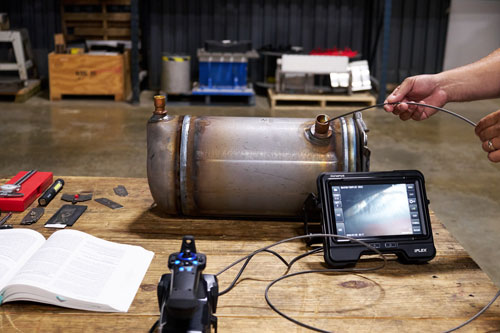
Visual inspection is the most widely used non-destructive testing (NDT) and non-destructive inspection method in the industry. It is performed daily across manufacturing, fabrication, and maintenance environments and serves as the first line of quality assurance. Studies consistently show that properly trained inspectors are significantly more effective at identifying relevant conditions and discontinuities. As a result, visual inspection is typically conducted on all components prior to performing additional non-destructive testing methods.
At American Testing Services, our experienced visual inspectors deliver comprehensive non-destructive testing and inspection services designed to save time and reduce overall inspection costs. Each inspection is performed with a thorough understanding of applicable codes and standards, material and manufacturing processes, anticipated service conditions, and acceptance criteria—ensuring reliable, compliant results that support downstream NDT methods.
Wire Rope
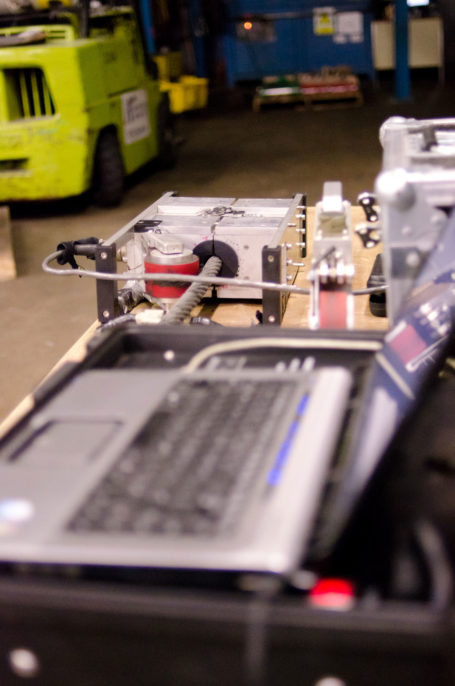
Wire rope inspection is a non-destructive testing (NDT) and non-destructive inspection method that uses computerized electromagnetic technology to evaluate ferrous wire ropes. This inspection technique detects and measures localized defects, material deterioration, and loss of metallic cross-sectional area, providing reliable assessment of both internal and external flaws without damaging the rope.
At American Testing Services, our advanced non-destructive testing and inspection services for wire rope inspection are capable of measuring relative changes in average metallic area as small as 0.1% and detecting localized flaws down to 0.05% of the nominal rope area. This level of sensitivity supports early detection, improved safety, and informed maintenance decisions for critical lifting and load-bearing applications.
Dedicated to Safety
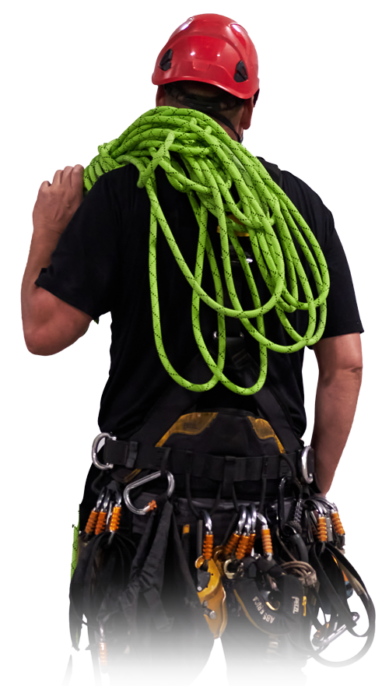
- All of our business is conducted in accordance with OSHA regulations. We have an excellent safety record with few lost time incidents.
- Our rope access technicians are independently trained and certified through SPRAT (Society of Professional Rope Access Technicians) every 3 years, which includes high angle rescue procedures.
- SPRAT membership provides our technicians with access to the latest standards, equipment, and tools.
- Rope access is statistically safer than scaffolds and uses fewer workers.
- We require a minimum of two technicians for all rope access work, enabling mutual surveillance.
- Our technicians work from two ropes – a working rope and a safety rope. Each rope is independently anchored, and the technician is permanently attached to both.
- Rope systems can be removed from a job site at the end of each shift, minimizing the chance of vandalism.
Nondestructive Testing vs. Metallurgy
Non-destructive testing and non-destructive inspection reveal what’s happening inside a material or component—without compromising its integrity. Metallurgical testing goes a step further, intentionally examining failure modes to understand how, why, and where a material may ultimately fail. Together, these disciplines provide a complete picture of performance, reliability, and risk—equipping you with critical insight before failure becomes a reality.
American Testing Services Offers Full Spectrum Solutions to Provide You With the Peace of Mind You Need.
To complement our non-destructive testing, we also provide consulting, equipment calibrations, and training.
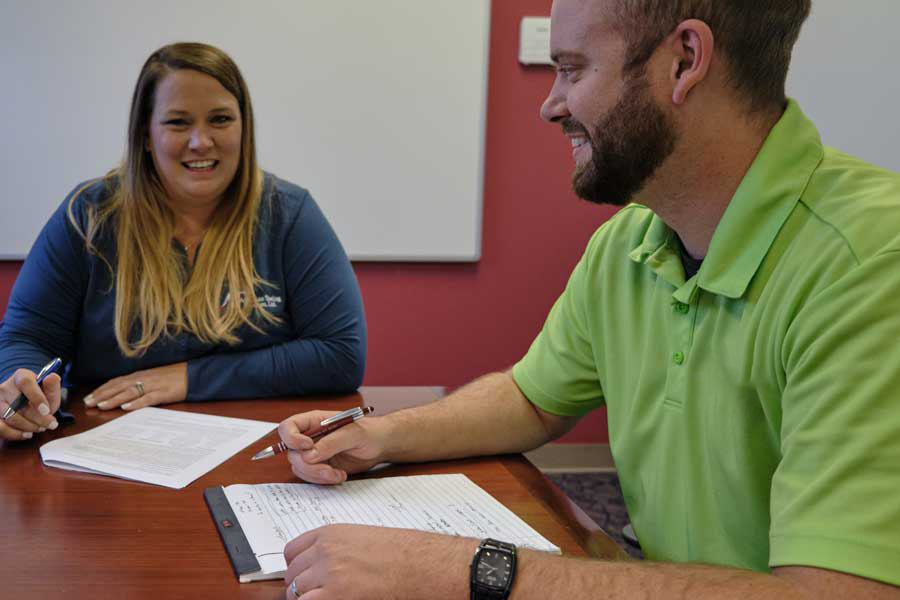
NDT Consulting
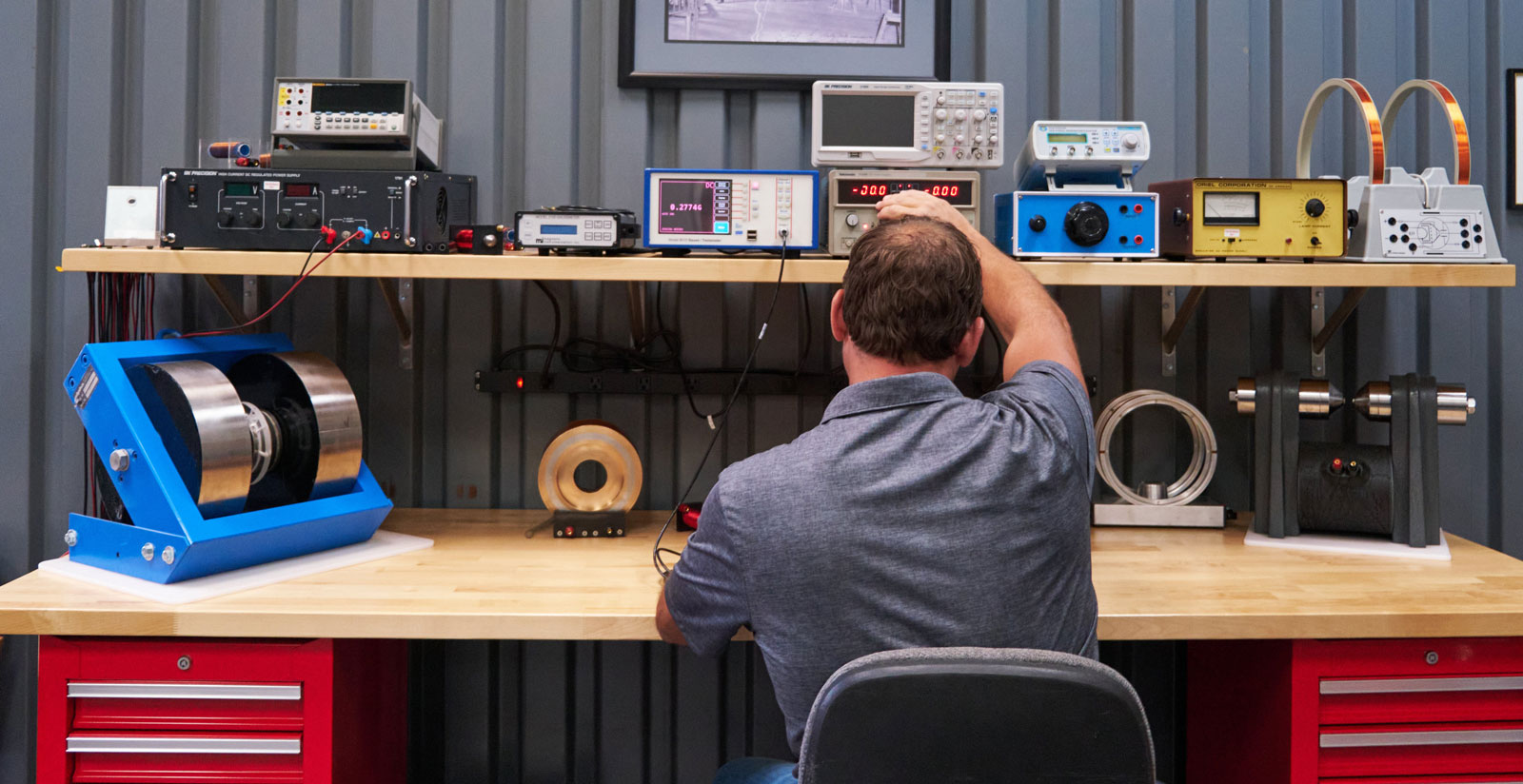
NDT Equipment Calibrations
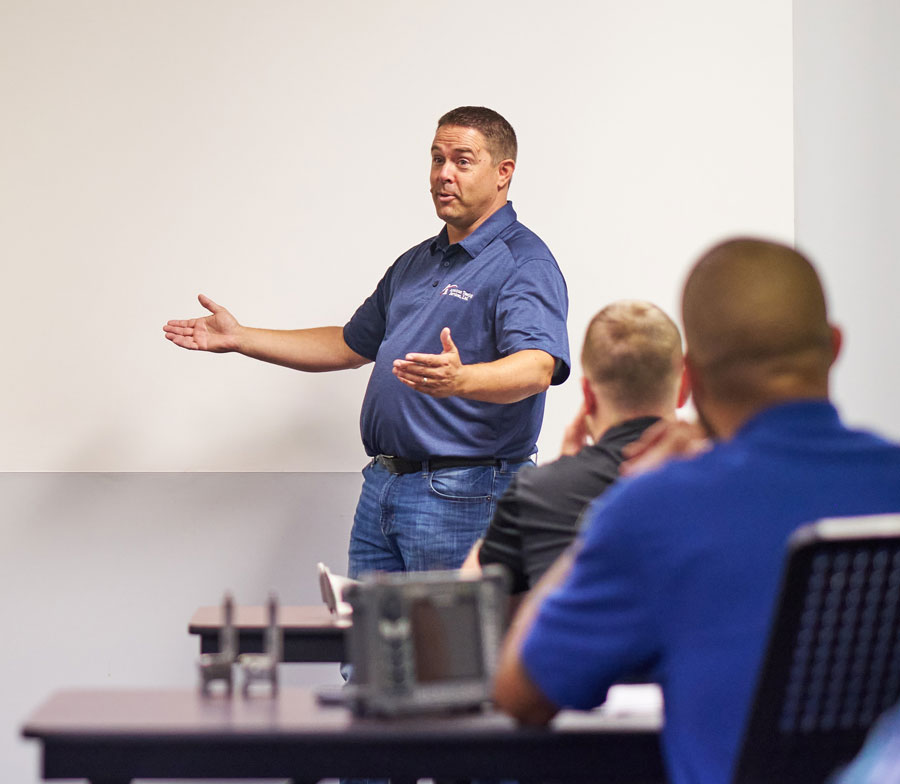
NDT Training
Non-Destructive Testing FAQs
Yes. Both describe methods that find flaws in a material, part or structure without damaging it. NDI is common in aerospace and military work; most other industries say NDT. Our post on why inspection matters for high-value parts explains how it protects parts that can’t be replaced.
Eddy current, ultrasonic, radiography and computed radiography, magnetic particle, liquid penetrant and visual inspection, plus bolt torquing, certified weld inspection (CWI) and wire rope inspection. For how NDT and destructive testing work together, see NDT vs. metallurgy.
Aerospace, military, commercial manufacturing, construction, foundry, fabricating and amusement. Read more about the industries that depend on NDT, how NDT keeps aircraft safe and the benefits of NDT.
Yes. Our NDT methods are available in our Miamisburg, Ohio, lab and in the field. Field technicians are trained in fall protection, confined space and personal protective equipment, and our rope access technicians are SPRAT-certified.
Jobs under 100 pieces typically turn around in 24 to 48 hours, excluding large projects and research. When a job calls for it, our lab can run 24/7.
Need NDT inspection on your schedule?
Tell us about the part and the deadline. We don’t just sell inspections. We sell peace of mind. Let us help you claim yours.